 Main Menu


Post
Intermediate wheatgrass as a dual use crop for grain and grazing

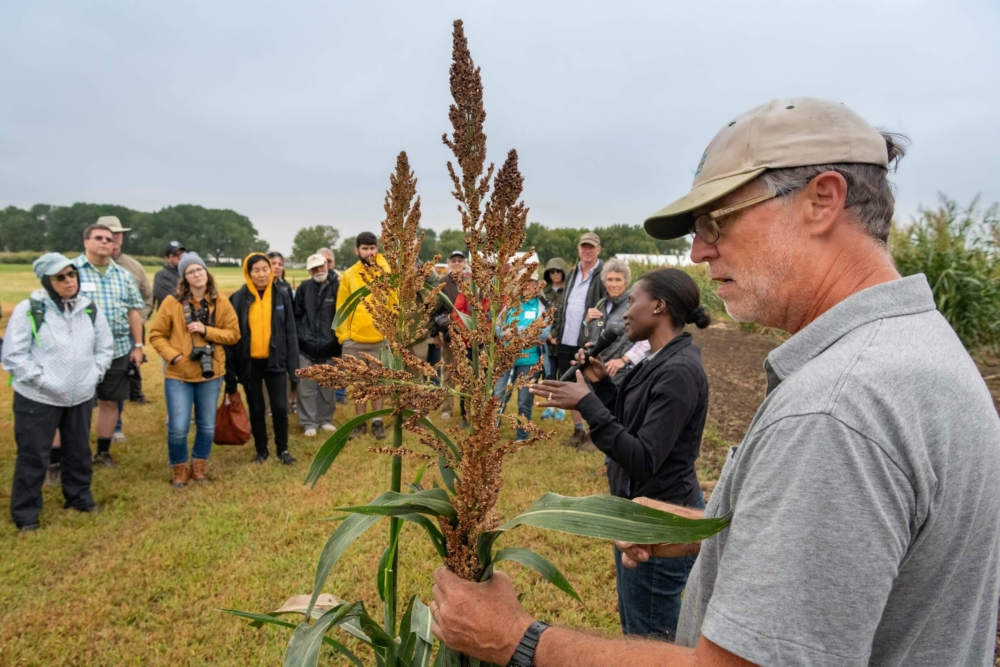
Perennial sorghum researchers at The Land Institute and the University of Georgia investigated how rhizome development and overwinter growth in the perennial grain may correlate with genomic regions and patterns, and further research could ultimately provide insights into future breeding efforts.
The genetic architecture of perenniality in sorghum remains incompletely understood, particularly following interspecific hybridization and recovery of diploid progeny. Rhizome development and overwinter regrowth are components of perennial persistence but may differ genetically and environmentally. Characterizing their genomic association patterns in diploid Sorghum bicolor × S. halepense material could identify candidate genomic regions for subsequent validation and breeding.
We investigated perenniality in S3011, a diploid-derived interspecific population from Sorghum bicolor × S. halepense. A structured F₄ panel was phenotyped under field conditions, and accession-level best linear unbiased predictors (BLUPs) were used for genome-wide association analyses. No association exceeded the Bonferroni-adjusted genome-wide significance threshold (P ≤ 1.15 × 10⁻⁶; 43,317 SNPs tested), and none remained significant after Benjamini–Hochberg false discovery rate correction (q < 0.05). A predefined suggestive threshold (P < 1 × 10⁻⁴; −log₁₀(P) > 4) identified 13 SNPs, which were consolidated into seven spatially distinct exploratory rhizome-number signals. Complementary characterization using high–low allele-dosage contrasts, local linkage disequilibrium, historical positional correspondence, candidate-gene annotation, and a descriptive marker-based genome scan revealed heterogeneous regional evidence. The strongest high–low allele-dosage differentiation occurred at chromosome 1 cluster 2 (S1_63359080; +0.3364; 100.0th chromosome-relative percentile), followed by chromosome 1 cluster 1 (S1_62967991; +0.3002; 99.3rd percentile). The complementary marker scan showed within-dataset cross-method concordance for selected rhizome-number signals, including the chromosome 3 region. Overwinter regrowth produced three exact marker-level GWAS–marker-scan matches but lacked the localized multi-marker regional structure observed for rhizome number. Because both association approaches used the same S3011 dataset, their agreement represents cross-method concordance rather than independent validation. Given the modest sample size, low trait heritability, and absence of associations surviving multiple-testing correction, all identified signals remain exploratory.
Rhizome development and overwinter regrowth showed contrasting genomic association patterns in the S3011 population. Rhizome number was associated with seven exploratory signals that differed in allele-dosage differentiation and complementary regional support, whereas overwinter regrowth showed marker-level concordance without comparable localized multi-marker structure. These results do not establish confirmed QTL or causal loci but prioritize genomic regions and allelic combinations for validation in independent populations and environments before their breeding utility can be established.