 Main Menu


Post
Intermediate wheatgrass as a dual use crop for grain and grazing


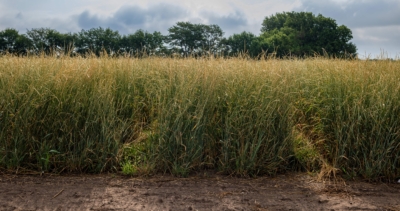
Researchers from The Land Institute and the University of Minnesota centered Kernza® perennial grain as a case study to assess the barriers to initiating a socially sustainable agricultural transition.
Scientists and practitioners working on sustainability transitions in agriculture are often concerned about both social and biophysical outcomes of efforts to address agriculture’s challenges. However, robust integration and operationalization of social dimensions in agricultural transition and innovation projects remain rare. Key barriers to assessing the social effects of sustainability transitions and scaling of innovations include limitations in social science capacity and resources, vague and divergent conceptual understanding of social sustainability, and few existing models for application. As the first step in a process to assess the social sustainability of Kernza® perennial grain production in the U.S. Midwest—our case of an emerging innovation and agricultural transition—we first undertake a conceptual review of social sustainability, attending to just, situated, and qualitative ways of framing and elucidating such sustainability. We draw on and expand upon bridge, development, and maintenance social sustainability frames, and we supplement this review with literature from sociology and the environmental social sciences and humanities. We then introduce a participatory methodology that uses key novel social dimensions and pilot social metrics for investigating whether an emerging sustainability innovation in agriculture is generating context-specific social changes for people who are enacting the transition on the ground. This methodology takes seriously that people doing the day-to-day work of agricultural transitions, including farmers and other value chain businesses, have visions for and expertise in social sustainability. Finally, we reflect on the bounding decisions we made while developing this methodology, and consider some directions forward for continuing to enrich its inclusiveness and relevance for participants in sustainability transitions. The methodology, social dimensions, and pilot social metrics can be adjusted and tested more widely across geographies, agricultural systems, and types of sustainability innovations. This research can support anyone working in this field toward deeper learning and action on social sustainability, and more rigorous and just approaches to assessing sustainability transitions.